The First Power Tools to Buy for Woodworking
As an Amazon Associate, this website earns from qualifying purchases.
The order to buy power tools in: why the drill/driver comes first, what earns its place second and third, why a table saw does not, and the safety rules that never bend.
- Level
- beginner
What you need
- Cordless drill/driver
- Random-orbit sander
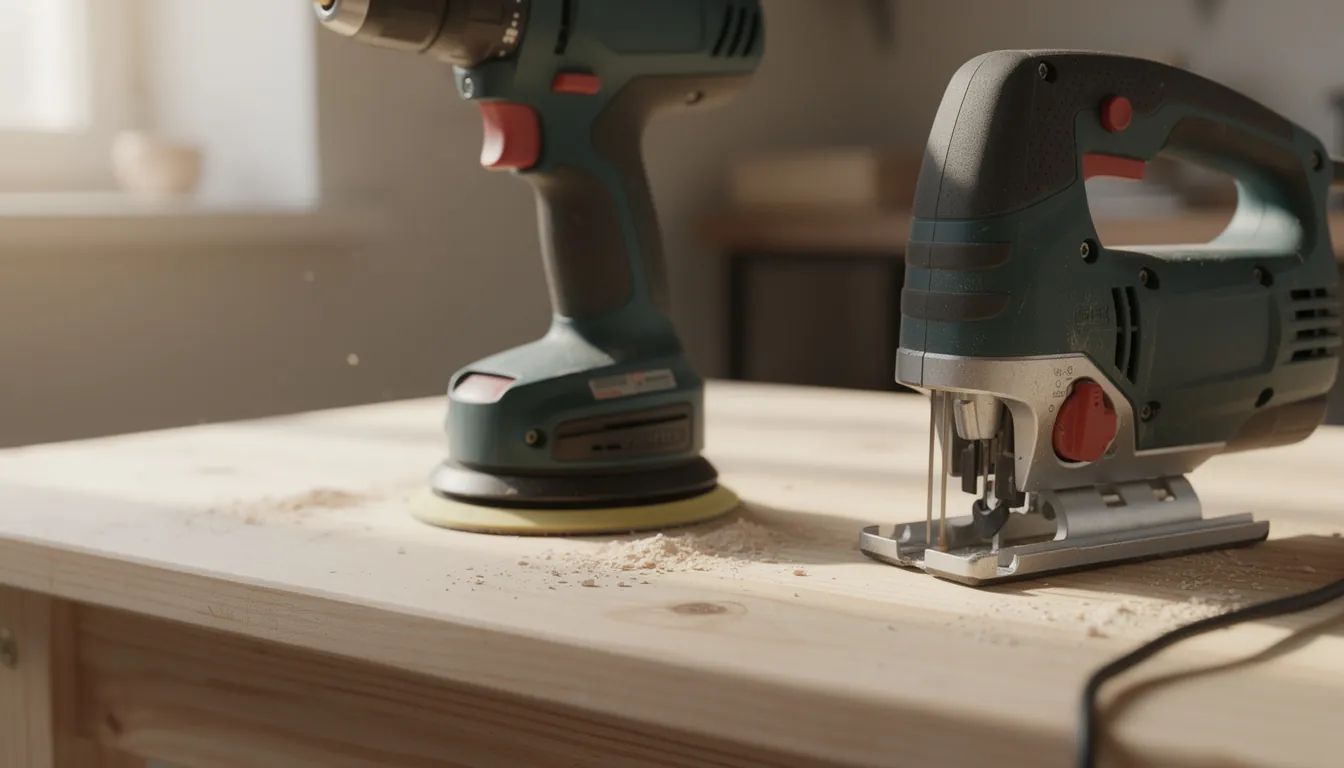
- Jigsaw, once curves come up
- Safety glasses
- Hearing protection
- Fine-particle dust mask
Missing something? Check prices on Amazon
Sections9
Decide before you spend
The question is not which power tool is best. It is whether you need to own this one at all. A beginner buying the tool list from a magazine ends up with a garage of machines and no finished projects, which is the opposite of what the beginner tool guide is trying to get you to. Work through buy, rent and borrow first, and the shopping list gets short. It also gets shorter still if you have already covered the essential hand tools, because the first three projects need no power tool at all.
Buy a tool you will use on most projects and around the house: the drill/driver, and eventually a sander. Rent a tool you need for one job and will not touch again for months, which is usually the large stationary machines. Borrow anything a friend or a relative already owns, especially for a first attempt, because using a tool before you buy it tells you more than any review. Some places also run a tool library or a maker space where you can use the big machines under supervision.
Own this one first: the drill/driver
A cordless drill/driver bores pilot holes and drives screws. Those two jobs turn up in nearly every project that is not held together by glue alone, and they are what the planter box and the wall shelf are built on.
What to look for: a keyless chuck you can grip and turn one-handed, a clutch collar with numbered settings, a variable-speed trigger that starts slowly rather than jumping, and two batteries so one is charging while you work. Brushless motors run longer on a charge and cost more; they are a nice-to-have, not a requirement. A kit with batteries, a charger and a case is usually better value than the bare tool.
For complete starter options, compare three cordless drill kits. Each includes a battery and charger, with different controls and accessory bundles to weigh against your projects.
The mistake beginners make is running it at full speed on the highest torque setting for everything. Use the clutch. Drilling and driving well is its own short skill, covered in drilling straight pilot holes and driving screws.
Second: the random-orbit sander
Hand sanding a small phone stand is fine. Hand sanding a glued-up cutting board is an afternoon of work you will resent. A random-orbit sander does that job in a fraction of the time and, because its pad moves in an irregular pattern, it does not leave the tight swirl marks a straight orbital leaves under a finish.
Look for a 125 mm / 5 in hook-and-loop pad, a dust port with a bag or a hose fitting, and low enough vibration that you can hold it for twenty minutes. Buy discs in a range of grits with the tool; running out of one grit mid-job is how people end up skipping steps they should not skip. See sanding and finishing for the grit progression itself.
Third: the jigsaw
A jigsaw cuts curves and rough openings, and it will crosscut a board when you guide it against a clamped straightedge. It is the cheapest way to add curves to your work.
It is not a precision tool out of the box. The blade can flex and wander, so the cut face often needs cleaning up. Buy decent blades, match the blade to the material, let the tool reach speed before it touches the wood, and support both sides of the cut so the offcut does not drop and snatch the blade.
Why a table saw is the wrong first purchase
This one gets argued about, so here it is plainly. A table saw is the tool a beginner is most often told to buy and the one that makes least sense to buy first.
- It is demanding to use safely. The workpiece moves toward a spinning blade, powered by your hands, and the technique that keeps that predictable takes instruction and practice. It is not a tool to learn alone from a video on your first weekend.
- It costs more than the rest of your kit combined. A saw good enough to be worth having, plus the blades and the push sticks, is a serious spend before you know whether you enjoy the hobby.
- It needs permanent space. Not just its footprint, but clear room in front and behind to feed a full board past the blade, and somewhere to stand that is not in line with it.
- Beginner projects do not need it. Every build in the first five is small stock, crosscut to length. A hand saw in a mitre box handles that, and the timber yard will break down sheet goods for you.
None of that is a moral point about danger. It is about sequence. Get five projects finished, learn what you keep reaching for, and if a table saw is still the answer in a year, buy it then with some idea of what you want from it.
Corded, cordless, and the battery trap
For a drill/driver, cordless wins. You carry it to the work, up a ladder, and across a room to a wall. For a sander or a jigsaw that lives at the bench near an outlet, corded is fine, often cheaper, and never flat.
The part that catches people is the battery platform. Batteries and chargers generally do not cross between brands, so your first cordless purchase quietly chooses the brand of your next three. That is a real cost, not a detail. Before you buy, look at what else that brand makes at your budget, whether the battery line is current or being phased out, and what a spare battery costs on its own. Mixing brands is not wrong; just do it knowing you are buying a second charger and a second set of batteries.
Safety, non-negotiable
Buy the protection at the same time as the tool, not after the first scare; safety glasses, ear defenders and a dust mask cost a fraction of the drill. These are the rules that do not bend, whatever tool is in your hand.
- Eye protection every time. Anything cut, drilled, driven or sanded can throw a chip.
- Hearing protection for power tools. Ear defenders or plugs. Hearing damage from noise builds up quietly and does not come back.
- A fine-particle dust mask for sanding. Wood dust is a respiratory hazard, not just a mess.
- Clamp the work, never hold it. A workpiece that spins with the bit is how hands get hurt.
- Guards stay on. Never defeat, tape or tie back a safety switch or guard.
- Unplug it, or take the battery out, before you change a bit or blade or clear a jam. Not "let go of the trigger". Power removed.
- No gloves, no loose sleeves, no dangling hair or cords near a rotating cutter. Gloves are for handling rough timber, not for running tools.
- Read the manual that came with your own tool. Anything here supplements it and never replaces it.
- Follow the label on every glue, finish and solvent you use nearby.
If a cut needs a machine you have not been shown how to use, or the work is structural, electrical, or too big to hold safely, stop and ask someone who knows. That is not failure. It is the cheapest decision in the hobby. The full set of rules lives in woodworking safety for beginners.
Dust extraction is not optional
Power sanding produces very fine dust that hangs in the air long after the tool stops, and that is the dust your lungs care about most. Use the tool's dust bag or hook it to a vacuum, work outdoors or by an open window when you can, and wear the mask.
When you clean up, do not sweep dust into the air with a dry broom. Vacuum it, or wipe surfaces with a damp cloth. Empty the bag or vacuum outside, not over the bin next to where you are working.
Where to go next
The drill is the tool you will use first and most, so learn it properly: drilling and driving covers pilot holes, countersinking, depth stops and why screws split boards near an end. If you are still deciding what wood to buy for that first build, the materials section on the tools guide is the shorter read, and the free First 5 Projects Roadmap splits every tool on this page into own, borrow, rent or buy later so you can spend in the right order.
Common questions
What is the first power tool a beginner should buy?
A cordless drill/driver. It bores pilot holes and drives screws, which are the two jobs that come up in almost every build once you move past glue-only projects. It is also the tool you will keep using around the house long after a project is finished, so it earns its place faster than anything else on the list.
Should I buy a table saw to get started?
No. A table saw is demanding to use safely, it costs more than the rest of a beginner kit put together, and it needs permanent floor space with room to feed a board past it. Beginner projects are small, and a hand saw in a mitre box or a jigsaw handles them. If a build genuinely needs sheet goods ripped, ask the timber yard to cut them.
Corded or cordless?
Cordless for a drill/driver, because you carry it to the work and often to a wall. Corded is fine and usually cheaper for a sander or jigsaw that stays at the bench near an outlet. The real cost of cordless is the battery platform, since batteries and chargers rarely cross between brands.
Can I use power tools in an apartment or shared space?
Often yes, with limits. Noise, dust and where you can clamp are the constraints, not the tools. Work on a solid surface you can clamp to, sand outdoors or next to an open window with extraction, keep the loud work to reasonable hours, and check your building rules before you start.
Is it worth buying a cheap combo kit?
A drill/driver plus one other tool from a known brand can be good value, especially if it includes two batteries and a charger. Be wary of kits padded with tools you have no use for. Judge it on whether you would have bought each item separately.
Get the free First 5 Projects Roadmap
Five projects in the order that builds confidence, the tool list split into own / borrow / rent / buy later, and a cut-list worksheet you can print and take to the timber rack.